
When we’re riding all together
It’s a different kind of world
- Maggie Rogers, Different Kind of World
“It takes a village” is one of those sayings I never get tired of—probably because I see it in action every single day. Just yesterday, I texted a friend to ask if she could drive my daughter to soccer practice while I was tied up in meetings. This morning, a coworker stepped in to cover part of a call so I could deal with a house issue. And last night, I attended our very first Booster Club meeting for the high school choir and band, where a handful of parents were brainstorming ways to support the arts in our community. That’s all in just two days, and I could easily list a hundred more examples.
Sometimes I feel overwhelmed by the big, heavy problems in the world. But looking at my own daily life reminds me how much the little things matter—how many people quietly hold each other up in ways that might never make headlines. And this happens all day every day.
That’s why this passage by Ella Risbridger resonates so strongly with me:
“If you are feeling hopeless and far away, find something close and practical to do. Call your grandmother. Talk to your neighbors. Cook for others. Exist with as much joy as you can; reach out to everyone you can; give everything you can wherever you can. This will not help globally. It will only help locally. But then the globe is just made up of small locations one after another, and we are all connected in ways that are both apparent and not yet apparent.”
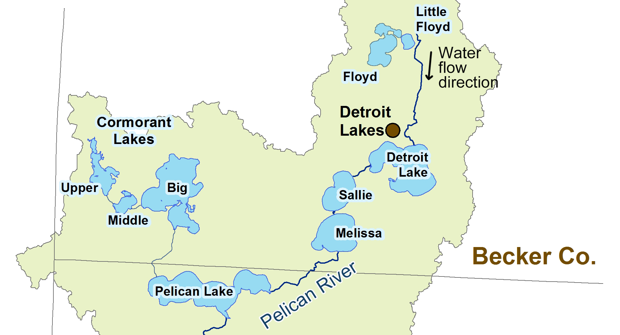
Her words capture exactly what I see in my own community: small acts adding up, rippling outward in ways we can’t always measure or even notice. And those ripples make me think of lakes in a watershed. When one lake improves—cleaner water, more trees and vegetation, healthier habitat—it doesn’t just stay there. Those benefits flow downstream, helping all the lakes connected to it. For example, Detroit Lake sits at the beginning of a chain of lakes along the Pelican River (see map below). A few years ago, the City of Detroit Lakes upgraded its wastewater treatment plant to reduce nutrient flow downstream. That improved the water quality of Muskrat, Sallie, Melissa, Little Pelican, Pelican, Lizzie, and Prairie Lakes—all the way to the Red River of the North.
It’s a good reminder that progress rarely happens in isolation—whether in lakes or in life. What begins in one place has a way of touching everything else downstream. I can’t fix everything (it’s too overwhelming), but I can drive a friend’s kid to practice, cover a meeting, or sit in a folding chair at a meeting for school. And somehow, those little acts don’t feel so small when they’re stacked together. Just like lake improvements better all the lakes downstream. If we each tend our own village and lake, those villages and lakes connect—and before long, the whole world feels a little stronger, a little kinder, and a little more beautiful.

Moriya Rufer is a lake biologist with 20 years experience working with and loving lakes in northern Minnesota.
Leave a Reply